
Am I a Minimalist? Finding Balance in Simplicity…
In the slow living space, Minimalism is often a core focus. For those unfamiliar, Minimalism is described as a style or technique… whether in music, literature, or design it is characterised by extreme spareness and simplicity. Think Marie Kondo, and you’re on the right track.
I’ve long felt drawn to Minimalism. I’ve read books like Essentialism: The Disciplined Pursuit of Less by Greg McKeown and Everything That Remains by The Minimalists. I love watching minimalist content, from documentaries to creators like Matt D’Avella, Madison Gray and Sarah Therese. But despite my interest, I’ve never fully identified as a minimalist.
Redefining Minimalism
The Minimalists describe it as a tool to remove excess so you can focus on what truly matters. That definition allows for a broad interpretation. But for me, the word Minimalism has always carried an extreme connotation. By my own (perhaps rigid) definition, my family and I don’t quite fit the minimalist mould.
Yes, we moved to the Outer Hebrides with just one removal van. But we still own too much. We have collections - books, records, board games (my partner’s, mostly). And, if I’m honest, the label Minimalism can feel like a high standard I’d never quite reach.
Instead, I feel more at home with Simple Living and Intentional Living. These take the pressure off my perfectionist shoulders. They allow me to focus on creating a home and lifestyle that work for us, without chasing some unreachable ideal.
Minimalism & Relationships
A big factor is that my partner is the opposite of a minimalist. He has bookshelves overflowing, a never-touched (but fiercely protected) board game collection, and even video cassette tapes… yes, actual VHS tapes! Musicians tend to accumulate stuff, and he’s no exception. He finds comfort in his things, and that’s okay.
We both come from families who hold onto things. His family is sentimental, filling every surface with trinkets from the past. Mine leans more toward consumer culture… buying new, trendy items but stashing old ones away. Both of these influences shape our relationship with stuff, making decluttering more complicated than just "getting rid of things."
Clutter & Mental Overload
As a neurodivergent person, I am easily overwhelmed, especially visually. Growing up, I shared a room with my sisters, and the only thing I could control was my wardrobe. It became an obsession… organising and reorganising, trying to create order in a chaotic space. I didn’t realise it then, but my overflowing wardrobe owned me.
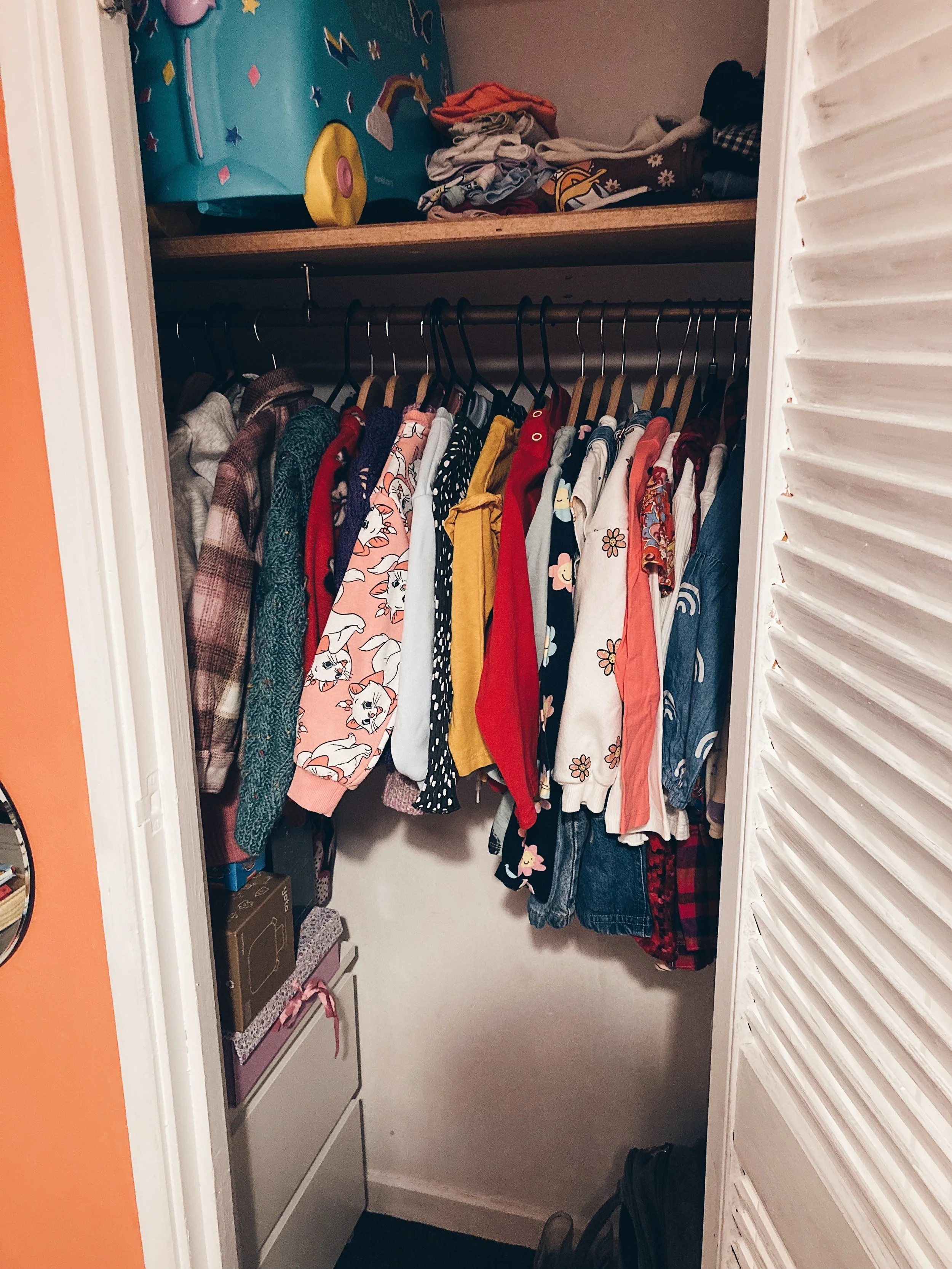
Even now, my own clothing is minimal compared to most, yet it’s still not capsule or seasonal. Living in the Hebrides means I need winter jackets year-round. My daughter’s wardrobe, on the other hand, has been a constant battle. Well-meaning friends and family love to gift her clothes, but the sheer volume has been overwhelming. Just recently, I cleared out four full bags (how did all that even fit in her tiny wardrobe?)
Toys, books, and stuffed animals are another area of constant struggle. If I feel overwhelmed, how must she feel?
The Energy Cost of Stuff
Years ago, before having a child, I started down this road to simplicity. And yet, clutter keeps creeping back in. And every item in our home requires energy… physical and mental, to maintain.
After a rough start to the year, I’ve been rethinking everything, including our relationship with stuff. I don’t want to waste precious energy managing things. So, I’m intentionally stepping back onto the path of simplicity… taking it one space at a time, making our home lighter and less overwhelming. (This does not include my partner’s things as he can manage his own collections!)
The Benefits of Living Simply
✔ Less Visual Clutter = Less Anxiety
For me, clutter is a massive trigger for stress. Having fewer items instantly reduces visual overwhelm, which, in turn, helps me feel calmer.
✔ Easier to Keep Tidy
As a mum, anything that makes cleaning easier is a win. Less stuff means less to clean, giving me more time for what truly matters… family, nature, hobbies, and rest.
✔ More Cost-Effective & Sustainable
I wouldn’t call myself a hardcore minimalist, but I am mindful of sustainability. Some bulk purchases (like eco-friendly toilet paper, laundry detergent, and household items) take up space, but they simplify my life in the long run. I also prefer second-hand shopping or investing in sustainable brands when possible.
✔ Mental Clarity & Peace
Ultimately, the goal of simplifying my home is to bring clarity and calm. It’s about creating a space where we feel safe and at ease and where our home supports us rather than drains us.
✔ Encourages Mindful Consumption
I’m far more intentional about what we bring into our home. Before buying something, I ask: Do we really need this? And if we do, can we source it second-hand or repurpose something we already own?
So… Am I a Minimalist?
At the start of this post, I would have said no. But now, I realise that I am - just in my own way.
I may not live in a stark, white-walled home with 30 perfectly curated possessions. But I do strive for a simpler, more intentional life. One where we own only what we need, what we love, and what truly adds value to our lives.
Maybe minimalism isn’t about how little you own. Maybe it’s about making space for what matters.
And in that sense… I think I am a minimalist after all.
Til Next Time | Lesley-Anne
